


he Bamiyan Buddhas: what happened to Afghanistan's giant statues
Search for the Bamiyan Buddhas and you find a tragedy: two giant statues that stood for nearly 1,500 years, until the Taliban blew them up in 2001. But the story runs deeper than that one act, and here is the part most articles skip. You can still stand in front of them. The niches remain, the caves remain, and we take travellers there every season.
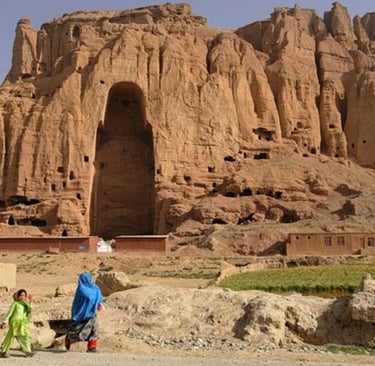
The two empty Bamiyan Buddha niches in the cliff
The Bamiyan Buddhas at a glance
Where
Bamyan valley, central Afghanistan
Carved
6th century
Height
About 55 m and 38 m
Destroyed
March 2001, by the Taliban
Status
UNESCO World Heritage site (in danger)
Can you visit?
Yes, the niches and caves are open
The tallest standing Buddhas in the world
Afghan carvers cut these Buddhas straight out of the sandstone cliff above Bamyan. They did not build and place them; they shaped the figures from the rock itself. What made them extraordinary:
The taller one reached about 55 metres, as high as an eighteen-storey building. The smaller stood about 38 metres.
For over a thousand years they held the record as the largest standing Buddhas on earth.
Painters coated them in plaster, colour and gold, so they blazed above the valley.
Locals named them Salsal and Shamama and spoke of them as a couple.
Hundreds of caves honeycomb the cliff around them, where monks once painted some of the oldest oil frescoes in the world.
[ IMAGE : gros plan sur la falaise et les grottes. Texte alt : monk caves around the Bamiyan Buddha niches ]
When Bamyan ruled the Silk Road
Picture this valley as a wealthy Buddhist kingdom at the crossroads of the Silk Road. Caravans hauled silk, goods and religions through it between China, India and Persia, and the trade made Bamyan rich.
Carvers shaped the Buddhas in the 6th century. When the Chinese monk Xuanzang walked through around the year 630, he described a Buddha "glittering with gold and precious ornaments" and thousands of monks living in the cliffs. The style blends Greek, Persian and Indian influences, the hallmark of Gandhara art.
How the Taliban destroyed them in 2001
In March 2001, the Taliban leadership branded the statues idols and ordered their men to destroy them. The rock fought back, so the work dragged on for weeks:
Fighters first fired anti-aircraft guns and artillery at the statues.
When that failed, they packed the figures with dynamite.
Museums, governments and Muslim leaders worldwide begged them to stop, and some offered to buy the statues or screen them from view.
The Taliban refused every offer.
What Genghis Khan and fourteen centuries had spared vanished in a matter of weeks.
What you can still see today
The two niches still gape in the cliff, vast and hollow, and the emptiness moves people more than a statue would. When you visit, you find:
The two giant niches at full scale, with the exact outline where each Buddha stood.
The staircases and tunnels carvers cut into the rock beside them, which you can still climb.
Painted caves with surviving fragments of fresco.
Wide viewpoints over the green valley and the snow peaks beyond.
Teams now store and study the fragments, and experts still argue whether to rebuild the Buddhas or leave the niches empty as a memorial. In 2015 a Chinese couple projected a 3D light image into the larger niche, and for one night the Buddha stood again.
How to visit the Bamiyan Buddhas
Here is what most people do not expect: Bamyan is one of the calmest and friendliest regions of Afghanistan, and the niches rise right above the town, so you walk straight to them.
Getting there: we drive over the central highlands from Kabul, a long but spectacular road that is half the experience.
On site: your local guide walks you into the caves, up the old staircases beside the niches, and out to the best viewpoints.
Pair it with Band-e-Amir: the turquoise lakes of Band-e-Amir sit an easy day trip away.
When to come: late spring to early autumn.
Bamyan features on our group tours, and we can build a longer stay into a private trip. For the wider region, see our Bamyan travel guide.
What travellers ask us first
How tall were the Bamiyan Buddhas?
The larger stood about 55 metres and the smaller about 38 metres, the tallest standing Buddhas in the world at the time.
Why did the Taliban destroy them?
They branded the statues idols against Islam and blew them up in March 2001, ignoring appeals from around the world.
Is there anything left to see?
Plenty. The vast niches, the painted caves and the carved staircases all remain, and you can visit them with a guide.
Can you actually travel to Bamyan?
Yes. It sits among the safer regions of the country, and we run trips there every season.
Come and stand where they stood
No photo prepares you for the scale of those empty niches. Join one of our group tours or build a private trip, and we will take you there.


UAE
B.C.1305543
4442612247
Contacts
@unique.afghanistan
uniqueafghanistan@proton.me
Unique Afghanistan