


Kandahar travel guide: what to see in the south
A traveller's guide to Kandahar, Afghanistan: the Shrine of the Cloak, the tomb of Ahmad Shah Durrani, Chil Zina, the bazaars and the famous pomegranates, plus how to visit safely.

Kandahar: Afghanistan's southern heartland
Kandahar is the country's second city and the cradle of Pashtun culture. It was Afghanistan's capital before Kabul, and it still feels like the historic heart of the south. Trade routes built it, empires fought over it, and it stays proud of its poets, its shrines and its orchards. The south asks for more planning than the north, and we travel there with extra care, but for the right traveller Kandahar is unforgettable.
Region
Southern Afghanistan
Known for
Pashtun culture, shrines, pomegranates
Best season
Autumn, September to November
Getting there
Flight or road from Kabul
Our take
Visited with extra precautions, always with a local team
The city that was once the capital
Kandahar ran the country before Kabul did. Ahmad Shah Durrani founded the Durrani Empire here in 1747, which is why he is often called the father of modern Afghanistan. A generation earlier, Mirwais Hotak led the city in a revolt against the Safavids that still shapes local pride. You feel that long memory everywhere you walk.
The Shrine of the Cloak
The Shrine of the Cloak holds what many believe to be a cloak worn by the Prophet Mohammad. It is one of the holiest places in Afghanistan, and the cloak itself has not been shown in public since 1996. Visitors approach with real respect, and access depends on the day and the situation.
The tomb of Ahmad Shah Durrani
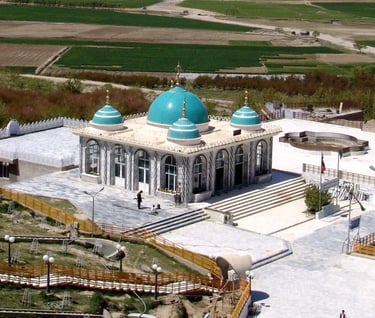
Right beside the shrine stands the octagonal mausoleum of Ahmad Shah Durrani, crowned by a bright dome and wrapped in fine tilework. It is the resting place of the empire's founder and one of the most photographed buildings in the south.
Chil Zina, the forty steps
On the edge of town, forty steps climb straight into a rock face to a chamber carved from the mountain. The Persian inscriptions here date to the Mughal emperor Babur and record his conquests. Reach the top and the whole Arghandab valley opens up below you.
The old city, the citadel and the bazaars
The Arg, the fortified old core, sits on raised ground and layers centuries of history one on top of another. Nearby, the Kandahar Museum gathers pieces from across the region, and the bazaars stay loud with traders, craftwork and the smell of grilled meat.
The pomegranate capital
Kandahar grows the finest pomegranates in Afghanistan, the famous kandahari anar. During the autumn harvest the orchards outside the city turn a deep red, and the markets fill with fruit. Tasting a Kandahar pomegranate at the source is one of the most sensory moments in Afghan travel.
How we visit Kandahar
We treat the south with more caution than the rest of the country. That means going with our Afghan team, holding the right permits, keeping groups small and reading the security picture day by day. If you want to understand how we handle risk across the country, our page on whether Afghanistan is safe to travel walks through it. When the timing is right, we fold Kandahar into a tailor-made trip or a longer group tours.
What travellers ask us about Kandahar
Is Kandahar safe to visit?
The south needs more care than the rest of the country, so we only go with our local team, the right permits and a route we read day by day. It is not the place for a first nervous trip, but it is doable and rewarding when it is organised well.
What is Kandahar known for?
Pashtun culture, some of the holiest shrines in the country, the tomb of Ahmad Shah Durrani, and the finest pomegranates in Afghanistan.
Was Kandahar the capital of Afghanistan?
Yes. Kandahar was the capital before Kabul, until 1776, and it was the seat of the Durrani Empire.
When is the best time to visit Kandahar?
Autumn, roughly September to November, when the weather eases and the pomegranate harvest fills the orchards and bazaars.
UAE
B.C.1305543
4442612247
Contacts
@unique.afghanistan
uniqueafghanistan@proton.me
Unique Afghanistan